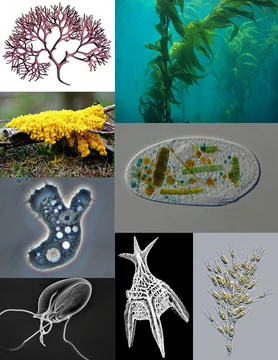
Flagellate
Organisms with whip-like flagella for movement and feeding.

A flagellate is a cell or organism with one or more whip-like appendages called flagella. The term describes a particular level of organization characteristic of many prokaryotes and eukaryotes and their means of motion, but does not imply any specific relationship or classification. Flagellates are major consumers of primary and secondary production in aquatic ecosystems, consuming bacteria and other protists, and many parasites that affect human health or economy are flagellates in at least one stage of their life cycle.
- field
- Biology, Protistology
- known_for
- Possessing flagella for propulsion and feeding; major ecological role in aquatic ecosystems; includes many parasites
- classification_notes
- Formerly grouped as Flagellata (Mastigophora), now recognized as polyphyletic; modern taxa include dinoflagellates, choanoflagellates, euglenids, and others
Lore & Background
In older classifications, flagellated protozoa were grouped in Flagellata (= Mastigophora), sometimes divided into Phytoflagellata (mostly autotrophic) and Zooflagellata (heterotrophic). These groups are now known to be highly polyphyletic. Modern classifications place principal flagellated taxa in groups such as Archaeplastida, Stramenopiles, Alveolata, Rhizaria, Amoebozoa, Opisthokonta, and Excavata. The term 'flagellate' is still used as a description of a level of organization and as an ecological functional group, with 'monadoid' as an alternative term.
Reader's Guide
The concept of flagellate is significant because it describes a fundamental cellular organization and mode of locomotion found across a vast diversity of life, from bacteria to complex eukaryotes. Although the taxonomic group Flagellata has been abandoned as polyphyletic, the term remains useful for describing organisms that share the flagellate level of organization and for ecological functional grouping. Flagellates play a crucial role in aquatic ecosystems as major consumers of bacteria and other protists, linking primary production to higher trophic levels. Many medically and economically important parasites, such as Naegleria, Trichomonas, and Plasmodium, are flagellates in at least one life stage, making their study vital for human health. The occurrence of flagellated cells in diverse groups—from green algae and ferns to chytrid fungi and animal spermatozoa—highlights the evolutionary conservation and versatility of the flagellum. The amoeboflagellates and helioflagellates further illustrate the plasticity of cellular organization, where cells may simultaneously or sequentially exhibit flagella and pseudopods or heliozoan structures. Thus, the flagellate concept bridges cell biology, evolution, ecology, and medicine.
Did You Know?
- Flagella in eukaryotes have a characteristic arrangement of nine fused pairs of microtubules surrounding two central singlets, arising from a basal body.
- Many parasites that affect human health or economy, such as Naegleria, Trichomonas, and Plasmodium, are flagellates in at least one stage of their life cycle.
- Flowering plants do not produce flagellate cells, but ferns, mosses, green algae, and some gymnosperms and closely related plants do.
- The term 'flagellate' does not imply any specific relationship or classification; the taxonomic group Flagellata was abandoned as highly polyphyletic.
Frequently Asked Questions
What exactly is a flagellate?
A flagellate is any cell or organism that propels itself or feeds using one or more whip-like structures called flagella. The term describes a structural and functional mode of organization rather than a single evolutionary lineage, so it spans both prokaryotes and eukaryotes.
What can flagellates actually do with their flagella?
Flagella serve as both propulsion engines and feeding tools, letting these organisms swim through water and capture bacteria or other protists. This dual role makes them major consumers of primary and secondary production in aquatic ecosystems.
Why was the old group 'Flagellata' (Mastigophora) scrapped?
Genetic and morphological evidence showed that flagella evolved independently multiple times, so lumping all flagellated organisms together produced a polyphyletic grab-bag rather than a true clade. Modern taxonomy instead sorts them into distinct lineages such as dinoflagellates, choanoflagellates, and euglenids.
Why do flagellates matter in aquatic food webs?
They occupy a critical mid-level consumer niche, eating free-living bacteria and smaller protists and passing that energy upward to larger organisms. Without them, the transfer of carbon and nutrients through ocean and freshwater ecosystems would be severely disrupted.
Do flagellates affect humans or the economy?
Yes—many parasites that impact human health or economic activity are flagellates during at least one stage of their life cycle. Their whip-like appendages let them navigate host tissues or water columns to reach and infect their targets.
More in Algae & Protists 1-19
Spotted an error? Know more?
This is a living reference — every entry is fact-audited, and reader corrections feed straight into our audit queue. Suggest an edit · See this site's audit record