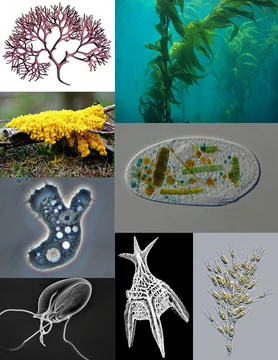
Chaos (genus)
A genus of giant, multinucleate amoebae closely related to Amoeba.

Chaos is a genus of single-celled amoeboid organisms in the family Amoebidae. The largest and best-known species, the so-called 'giant amoeba' (Chaos carolinense), can reach lengths up to 5 mm, although most specimens fall between 1 and 3 mm. Members of this genus closely resemble those of the genus Amoeba and share the same general morphology, producing numerous cylindrical pseudopods, each rounded at the tip, but while Amoeba have a single nucleus, Chaos can have as many as a thousand.
- field
- Protistology
- known_for
- Giant multinucleate amoebae; historical confusion with Amoeba and Pelomyxa; model organism for cell biology studies
- classification
- Genus in family Amoebidae, order Tubulinida, supergroup Amoebozoa
- type_species
- Chaos carolinense (formerly Pelomyxa carolinensis)
- distinctive_feature
- Up to 1,000 nuclei per cell; lacks a mouth or cytostome
Lore & Background
The genus Chaos has had a long and often confusing history. Three years later, Linnaeus gave Rösel's creature the name Volvox chaos, but because the name Volvox had already been applied to a genus of flagellate algae, the name Chaos chaos was later introduced by other authors, not by Linnaeus as a direct renaming. In subsequent decades, accounts of Chaos, under a variety of synonyms, became so thoroughly entangled with descriptions of similar organisms that it is virtually impossible to differentiate one historic amoeboid from another. H. V. Wilson discovered and isolated a giant amoeba that resembled Amoeba proteus but had cellular nuclei numbering in the hundreds. Since there existed already a genus of giant multinucleate amoebae, Pelomyxa, Wilson placed his organism in that taxon, naming it Pelomyxa carolinensis. This amoeba was easily cultivated and became a widely distributed and studied laboratory organism. Several investigators argued vigorously against that name, but others adopted it. A third faction accepted the genus Chaos but retained the second half of the binomial, referring to the organism as Chaos carolinensis. By the early 1970s, all three names were in use concurrently. Studies of fine structure and physiology made it increasingly clear that there were profound differences between it and other Pelomyxa (including the complete absence, in true Pelomyxa, of mitochondria). Since then, a nomenclatural consensus has emerged, and today the organism is generally known as Chaos carolinensis, as first proposed by Robert L. King and Theodore L.
Reader's Guide
Chaos species are versatile heterotrophs, able to feed on bacteria, algae, other protists, and even small multicellular invertebrates. Like all Amoebozoa, they take in food by phagocytosis, encircling food particles with their pseudopodia, then enclosing them within a food vacuole, where they are broken down by enzymes. The cell does not have a mouth or cytostome, nor is there any fixed site on the cell membrane at which phagocytosis normally occurs. The cell's membrane is extremely flexible, allowing the organism to change shape from one moment to the next. The cytoplasm is conventionally described as having two parts: the internal fluid endoplasm, containing loose granules, food vacuoles, and organelles; and a more viscous ectoplasm around the perimeter, which is relatively clear. Like other lobose amoebae, Chaos move by extending pseudopodia. As a new pseudopod is extended, a variable zone of ectoplasm forms at the leading edge and a fountaining stream of endoplasm circulates within. The effort of describing these motions has generated a large body of scientific literature. Molecular phylogenetic studies have confirmed the view of some earlier researchers that Chaos is more closely related to Amoeba than to Pelomyxa. The species is now placed in the independent genus Chaos, a sister group to Amoeba. Until quite recently, the genus Chaos was included in the phylum Sarcodina, but molecular phylogenies based on ribosomal DNA have shown that Sarcodina is a polyphyletic grouping. Consequently, Chaos and its close relative Amoeba are now placed in the supergroup Amoebozoa, within the order Tubulinida. While the monophyly of Amoebozoa has yet to be established, current information confirms the status of Chaos and Amoeba as closely related taxa. However, the same research raises questions about the monophyly of the genus Chaos, since Chaos nobile may be basal to a group containing Chaos carolinense and at least two species of Amoeba.
Did You Know?
- The largest species, Chaos carolinense, can reach lengths up to 5 mm, though most specimens are between 1 and 3 mm.
- Chaos can have as many as a thousand nuclei, unlike the single-nucleus Amoeba.
- Chaos species lack a mouth or cytostome; they take in food by phagocytosis at any point on the cell membrane.
Taxonomic Identity and Phylogenetic Reassessment
Amoebae, far from constituting a single evolutionary family, are scattered across virtually every major branch of the eukaryotic tree of life. These shape-shifting cells appear among protozoa, but also within fungi, algae, and even animal lineages, making them a morphological convergence rather than a taxonomic unity. For much of the twentieth century, microbiologists lumped most of these organisms into a class called Sarcodina, defined by the shared trait of pseudopod-based locomotion or protoplasmic flow. That arrangement, however, has been dismantled by modern molecular phylogenetic research. Genetic analyses revealed that Sarcodina is not monophyletic; its members do not all trace back to a single common ancestor. As a result, contemporary classification no longer groups amoeboid organisms under one heading. Instead, the term "amoeba" or "amoeboid" has become a functional descriptor, applied by microbiologists to any cell or organism that exhibits the characteristic ability to extend and retract cytoplasmic projections for movement and feeding, regardless of its deeper evolutionary placement.
Pseudopods, Locomotion, and Structural Diversity
Because amoeboid cells lack rigid cell walls, they enjoy a freedom of shape change that rigid-walled organisms simply cannot achieve. The engine behind this flexibility is the pseudopod, a temporary bulge of cytoplasm generated when coordinated actin microfilaments push the surrounding plasma membrane outward. The morphology of these projections serves as a key diagnostic feature among groups. Amoebozoan species like those in the genus Amoeba produce bulbous, rounded lobose pseudopods. Cercozoan forms such as Euglypha and Gromia extend slender, thread-like filose extensions. Foraminifera emit fine, branching pseudopods that interconnect into net-like reticulose lattices. Meanwhile, Radiolaria and Heliozoa deploy stiff, needle-like axopodia reinforced internally by bundles of microtubules. Beyond locomotion, amoebae also differ in their external architecture: some are "naked" gymnamoebae with no covering, while testate species encase themselves in shells of calcium, silica, chitin, or agglutinated particles like sand grains and diatom frustules. Freshwater species additionally rely on a contractile vacuole to expel osmotically driven water influx, a structure largely absent in their marine counterparts where solute concentrations are balanced.
Notable Species and Ecological Niches
Among the vast diversity of amoeboid life, a handful of species have achieved particular prominence in both research and public awareness. Chaos carolinense and Amoeba proteus stand out as the most widely cultivated and studied examples, routinely encountered in classroom laboratories and research settings. At the other end of the spectrum, Naegleria fowleri has earned the grim nickname "brain-eating amoeba" for its pathogenic potential, while Entamoeba histolytica is the intestinal parasite responsible for amoebic dysentery. The multicellular Dictyostelium discoideum, often called a "social amoeba" or slime mould, represents a fascinating departure from the typical unicellular model. Size variation across the group is staggering: the marine Massisteria voersi measures a mere 2.3 to 3 micrometres, comparable to many bacteria, whereas the shells of deep-sea xenophyophores can reach 20 centimetres in diameter. Most pond and ditch dwellers are microscopic, but "giant amoebae" like Pelomyxa palustris and Chaos carolinense are large enough to observe with the unaided eye. Nutritionally, these organisms span predatory and detritivore lifestyles, ingesting food through phagocytosis or absorbing dissolved nutrients via pinocytosis.
Sexual Reproduction and Deep Evolutionary Roots
For a long time, amoebae were assumed to be exclusively asexual, yet accumulating genetic and biochemical evidence has upended that assumption. In the Acanthamoeba genome, researchers identified orthologs of core meiotic genes, including Spo11, Mre11, Rad50, Rad51, Rad52, Mnd1, Dmc1, Msh, and Mlh, strongly suggesting that this lineage is capable of meiosis and potentially sexual reproduction. In Entamoeba histolytica, the meiosis-specific recombinase Dmc1 is actively expressed; when purified, it forms presynaptic filaments and catalyses ATP-dependent homologous DNA pairing and strand exchange over thousands of base pairs, a reaction enhanced by the Hop2-Mnd1 accessory heterodimer. Similar meiotic recombination signatures appear in Entamoeba invadens during the transition from trophozoite to cyst. Dictyostelium discoideum, meanwhile, undergoes full mating and meiosis when food becomes scarce. Because Amoebozoa branched off very early in eukaryotic evolution, these findings imply that meiosis was already present among the earliest eukaryotes, supporting the hypothesis that the majority of amoeboid lineages are anciently sexual.
Frequently Asked Questions
What is Chaos (genus)?
Chaos is a genus of single-celled amoeboid protists in the family Amoebidae, order Tubulinida, supergroup Amoebozoa. Its members are best known as giant, multinucleate cells that can house up to a thousand nuclei within one body.
How does Chaos differ from the genus Amoeba?
Both genera produce rounded, cylindrical pseudopods and share a similar overall body shape, but the key distinction is nuclear count: Amoeba cells carry a single nucleus, while a single Chaos cell can hold as many as one thousand. Chaos also lacks a dedicated mouth or cytostome structure.
How large can Chaos carolinense grow?
The type species, Chaos carolinense (once catalogued as Pelomyxa carolinensis), is nicknamed the 'giant amoeba' because individuals can stretch to roughly 5 mm in length. Most specimens found in the wild are smaller, typically falling between 1 and 3 mm.
Why was Chaos historically confused with Pelomyxa?
For decades, Chaos carolinense was classified under the name Pelomyxa carolinensis, reflecting genuine taxonomic uncertainty about where the genus belonged. The close morphological resemblance between these amoeboid groups made separation difficult until reclassification confirmed Chaos's placement within Amoebidae.
Why is Chaos important to cell-biology research?
Because a single Chaos cell can pack up to a thousand nuclei into one shared cytoplasm without cell walls, it serves as a valuable model organism for studying multinucleate coordination. Researchers exploit this to explore nuclear division, cytoplasmic organization, and how multiple genomes operate within one cell.
More in Algae & Protists 1-19
Spotted an error? Know more?
This is a living reference — every entry is fact-audited, and reader corrections feed straight into our audit queue. Suggest an edit · See this site's audit record