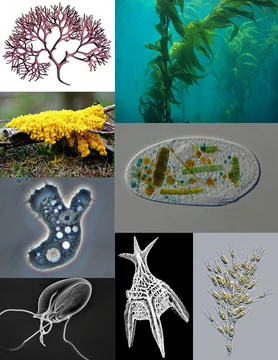
Diatom
Microalgae that produce much of Earth's oxygen and ocean organic matter.

Diatoms are a large group of microalgae found in oceans, waterways, and soils worldwide. They generate a significant portion of Earth's oxygen and constitute nearly half of the organic material in the oceans, making them crucial to global biogeochemical cycles.
- field
- Phycology
- known_for
- Silica frustules, major oxygen producers, foundation of marine food webs
- size_range
- 2 to 2000 micrometers
- life_span
- Maximum about six days
- doubling_time
- Approximately every 24 hours
Lore & Background
Diatoms are unicellular organisms that occur as solitary cells or in colonies shaped like ribbons, fans, zigzags, or stars. They are surrounded by a cell wall made of silica called a frustule, which produces structural coloration, leading to descriptions such as 'jewels of the sea' and 'living opals.' Diatoms are divided into two groups: centric diatoms, which are radially symmetric, and pennate diatoms, which are bilaterally symmetric. Movement is primarily passive via currents and turbulence, though male gametes of centric diatoms have flagella for active movement. Diatoms convert light energy to chemical energy through photosynthesis, and unusually for autotrophic organisms, they possess a urea cycle, a feature shared with animals but used for different metabolic ends. Some diatoms, such as those in the family Rhopalodiaceae, have a cyanobacterial endosymbiont that fixes atmospheric nitrogen.
Reader's Guide
Diatoms are among the most significant organisms on Earth due to their role in oxygen production and carbon cycling. They generate an estimated 20 to 50 percent of the planet's oxygen annually and take in over 6.7 billion tonnes of silicon each year from waters. Their shells form a major component of marine sediment, and diatom shell dust from the African Sahara fertilizes the entire Amazon basin annually. Diatoms are used to monitor past and present environmental conditions and water quality. Diatomaceous earth, a collection of diatom shells, is used for water filtration, as a mild abrasive, in cat litter, and as a dynamite stabilizer. The study of diatoms is a branch of phycology, and they are classified as eukaryotes.
Did You Know?
- Diatoms generate about 20 to 50 percent of the oxygen produced on Earth each year.
- The entire Amazon basin is fertilized annually by 27 million tons of diatom shell dust from the African Sahara.
- Diatoms have a unique silica cell wall called a frustule, which gives them structural coloration.
- The oldest fossil evidence for diatoms is a specimen of the genus Hemiaulus in Late Jurassic aged amber from Thailand.
Taxonomic Placement in the Supergroup Architecture
Diatoms occupy a position within the Stramenopiles, one of the major eukaryotic supergroups that also encompasses brown algae and, alongside Alveolata, harbors diverse flagellated forms. Their classification has shifted dramatically over time. Historically, organisms like diatoms were lumped into broad categories such as algae or protozoa within the old plant and animal kingdoms, or placed in a catch-all kingdom called Protista. The arrival of molecular phylogenetics and electron microscopy revealed that seemingly unrelated forms were actually evolutionarily connected in unexpected ways. Diatoms, as phototrophic members of Stramenopiles, sit in a supergroup that also contains lineages that evolved into major parasites like oomycetes. This reclassification underscored that old kingdom-level boundaries were artificial, and that diatoms' true evolutionary neighbors include both photosynthetic and heterotrophic lineages. In modern taxonomy, they are no longer defined by a single unifying trait but by their placement within a clade spanning a wide range of nutritional strategies and body forms.
Engines of Global Carbon Fixation
As phototrophic protists, diatoms contribute to what is described as a large portion of global primary production and carbon fixation. They function as producers within biogeochemical cycles and trophic webs, converting light energy through their chloroplasts into organic matter that feeds countless other organisms. Their role extends beyond simple photosynthesis: as components of trophic webs, they support consumers and decomposers that regulate fungal and bacterial populations and release nutrients to higher trophic levels. Diatoms are abundantly present across all ecosystems, including extreme habitats, making their contribution to carbon cycling a global phenomenon rather than a localized one. However, their ecological influence is not exclusively positive. As free-living protists, they can participate in harmful algal blooms that negatively impact aquatic life, demonstrating that even the most productive primary producers can tip ecosystems into imbalance when their populations surge unchecked.
Cellular Architecture and Reproductive Complexity
Like other protists, diatoms possess a complex cytoskeleton built around relatively conserved structural elements, including a flagellar apparatus with basal bodies from which microtubules emerge to support the remaining cellular architecture. Their phototrophic lifestyle relies on chloroplasts, but many protists in their broader group also exhibit mixotrophy, blending photosynthetic and heterotrophic nutrition. Diatoms are not limited to asexual reproduction; like their protist relatives, they are capable of sexual reproduction and can display diverse, complex life cycles involving different generations and life stages. Their cells tend to host symbiotic partners such as bacteria and archaea, typically to support metabolic and nutritional processes. They may also possess specialized organelles like contractile vacuoles for maintaining homeostasis. Their siliceous shells, which form a major component of the protist fossil record, represent a unique structural adaptation that distinguishes them morphologically from many other phototrophic lineages.
Deep Time and the Fossil Legacy
The evolutionary story of diatoms is embedded in the broader narrative of eukaryotic diversification. Eukaryotes split from archaea roughly three billion years ago, eventually producing a last eukaryotic common ancestor equipped with mitochondria and a complex endomembrane system during the Paleo- or Mesoproterozoic eras. Following the emergence of this ancestor, its descendants underwent rapid diversification over approximately 300 million years, giving rise to the modern supergroups, including Stramenopiles, where diatoms reside. For much of this early period, protist fossils were sparse. It was not until the Neoproterozoic that the first fossils of opisthokonts, amoebae, and multicellular algae appeared. Throughout the Phanerozoic, protists evolved into the forms that dominate ecosystems today, and diatoms left behind an extensive fossil record characterized primarily by their siliceous shells. These mineralized remains provide a tangible window into ancient phototrophic communities that shaped Earth's oceans long before complex life diversified on land.
Frequently Asked Questions
Who is Diatom?
Diatom is a vast family of microscopic algae living in oceans, rivers, lakes, and even soil around the planet. In phycology they're best known for their intricate glass-like silica shells, called frustules, which give them a jewel-like appearance under a microscope.
What are Diatom's powers or role?
Diatoms churn out a huge fraction of the oxygen in Earth's atmosphere and account for nearly half of all organic material floating in the ocean. They anchor marine food webs, feeding everything from tiny zooplankton up to whales.
How does Diatom's story end?
Each individual diatom lives for roughly six days at most before its lifecycle wraps up. The population, however, keeps cycling forward, doubling in number about every 24 hours under the right conditions.
Why is Diatom important to the bigger picture?
They are central engines of global biogeochemical cycles, locking away carbon while releasing oxygen in enormous quantities. Remove them and both marine ecosystems and the atmosphere would be fundamentally reshaped.
How big is Diatom compared to other characters?
Specimens span from a mere 2 micrometers all the way up to 2000 micrometers, meaning the tiniest are nearly invisible to the naked eye while the largest are just barely visible without magnification.
More in Algae & Protists 1-19
Spotted an error? Know more?
This is a living reference — every entry is fact-audited, and reader corrections feed straight into our audit queue. Suggest an edit · See this site's audit record