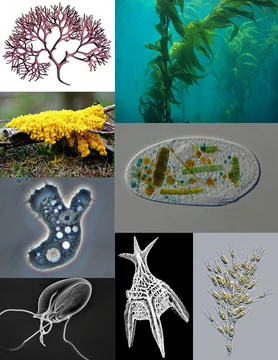
Brown algae
Multicellular seaweeds of temperate and polar marine waters.

Brown algae (sing.: alga) are a large group of photoautotrophic, multicellular SAR comprising the class Phaeophyceae. They include many seaweeds located in colder waters of the Northern Hemisphere and are the major seaweeds of temperate and polar regions.
- classification
- Class Phaeophyceae, within Stramenopiles (SAR supergroup)
- key_pigment
- fucoxanthin
- habitat
- Marine, especially colder waters of the Northern Hemisphere
- closest_relative
- Schizocladia isciensis
Lore & Background
Brown algae exist in a wide range of sizes and forms, from tiny feathery tufts of threadlike cells a few centimeters long to giant kelps exceeding 50 meters. All brown algae are multicellular, with no known single-celled or colonial species. Their characteristic olive-green to brown color comes from the pigment fucoxanthin, and they can change color depending on salinity. The body of a brown alga is termed a thallus, lacking the complex xylem and phloem of vascular plants. Structurally differentiated species possess a holdfast (rootlike anchor), a stipe (stemlike structure), and blades or laminae (flattened, leaflike portions). Gas-filled floats called pneumatocysts provide buoyancy, keeping the blades near the water surface for photosynthesis. Growth can be rapid; fronds of Macrocystis may grow as much as 50 cm.
Reader's Guide
Brown algae are significant as the dominant seaweeds in temperate and polar regions, forming critical marine habitats such as kelp forests (e.g., Macrocystis) and floating mats (e.g., Sargassum). They contribute to carbon fixation and are used by humans as food, notably kelps. Their chloroplasts, surrounded by four membranes, indicate a secondary symbiotic origin from a stramenopile and possibly a red or green alga. Brown algae are unique among Stramenopiles in developing multicellular forms with differentiated tissues, though they still reproduce via flagellated spores and gametes. Genetic studies place their closest relative as Schizocladia isciensis, followed by yellow-green algae. Some species, like Ascophyllum nodosum, are commercially important and extensively researched.
Did You Know?
- Brown algae are the only major group of seaweeds that does not include single-celled or colonial forms.
- Brown algae belong to the Stramenopiles clade, not to the archaeplastids (which include red algae, green algae, and green plants).
- Some brown algae, such as Sargassum, create unique floating mats in the Sargasso Sea that serve as habitats for many species.
Ecological Role & Habitat Diversity
Brown algae serve as foundational organisms in marine ecosystems across temperate and polar regions. They function simultaneously as a food source and as structural habitat for countless other species. The giant kelp Macrocystis, a member of the order Laminariales, can stretch to roughly 60 meters in length and builds vast underwater forests teeming with biodiversity. In a strikingly different setting, Sargassum species assemble into floating mats of seaweed in the tropical waters of the Sargasso Sea, creating a unique pelagic habitat that shelters numerous marine organisms. Along rocky seashores, members of the order Fucales form dense communities that define the intertidal landscape. Most brown algae inhabit marine environments, and their ecological importance extends to carbon fixation, where they play a meaningful role in cycling atmospheric carbon into biological material. As the dominant seaweeds of colder waters in the Northern Hemisphere, they shape entire ecosystems from the seafloor to the water column, supporting food webs that extend far beyond the algae themselves.
Morphological Diversity & Structural Complexity
Brown algae display an extraordinary range of body forms, from microscopic threadlike tufts just a few centimeters long to the giant kelp Macrocystis pyrifera, which exceeds 50 meters and stands as the largest of all algae. The smallest members may even reduce to a few cells during part of their life cycle, rendering the entire organism invisible to the naked eye. At the other extreme, rockweeds and leathery kelps dominate their habitats as the most visually striking algae present. In terms of shape, the group spans delicate felt-like strands seen in Ectocarpus, fan-shaped flattened branches up to 30 centimeters long in Padina, small crusts and cushions, and broad leafy free-floating mats. Despite this diversity, every brown alga shares a thallus body plan that lacks the xylem and phloem of vascular plants. Yet structurally complex species develop a holdfast for anchoring, a stipe that may contain a central pith, cortex, and epidermis, and flattened blades or fronds. In Nereocystis, the stipe center is hollow and gas-filled for buoyancy, while in Macrocystis pyrifera the stipe remains flexible enough to withstand strong currents.
Evolutionary Lineage & Distinctive Biochemistry
Brown algae occupy a distinctive position within the tree of life. They belong to the Stramenopiles clade within the SAR supergroup of eukaryotes, which places them far from red algae, green algae, and all green plants that fall under the archaeplastid lineage. Their chloroplasts are encased in four membranes, a hallmark suggesting the organelle was acquired through a secondary symbiotic event in which a stramenopile engulfed a red or green algal ancestor. Most brown algae carry the pigment fucoxanthin, which imparts the characteristic olive-green to brownish coloration from which the group takes its name; the exact shade shifts with the concentration of this carotenoid, and some species even alter their hue from reddish to brown in response to salinity changes. Genetic analyses identify Schizocladia isciensis as the closest known relative of brown algae, followed by the yellow-green algae. Uniquely among Stramenopiles, brown algae evolved into multicellular organisms with differentiated tissues, yet they still reproduce through flagellated spores and gametes that closely mirror the cellular architecture of their single-celled stramenopile kin.
Human Interaction & Scientific Significance
Kelps and other members of the class are harvested as food, while species like Ascophyllum nodosum have become focal points of extensive research owing to their commercial value. Beyond direct consumption, brown algae contribute to environmental health through carbon fixation, capturing atmospheric carbon and incorporating it into biological tissue. Their ecological weight is further underscored by the fact that they form the backbone of temperate and polar marine communities, serving as both nourishment and shelter for a wide array of organisms. The group's biological distinctiveness—being the only major seaweed lineage in which every known species is multicellular, with no single-celled or colonial representatives—makes them a compelling subject for evolutionary and developmental biology. Whether studied for their role in carbon cycling, their commercial applications, or their unique position among Stramenopiles, brown algae remain a rich and multifaceted area of scientific inquiry.
Frequently Asked Questions
Who is Brown algae?
Brown algae are a large group of multicellular, photoautotrophic organisms placed in the class Phaeophyceae within the Stramenopiles (SAR supergroup). In everyday terms, they are the seaweeds you'd spot swaying in cold northern seas.
What are Brown algae's powers/role?
They photosynthesize with the accessory pigment fucoxanthin, which gives them their signature brownish-green hue. Ecologically, they build vast kelp forests that act as nursery and feeding grounds for a huge range of marine animals.
Where does Brown algae live?
They are strictly marine and favour the colder waters of the Northern Hemisphere, dominating temperate and polar coastal zones. Rocky shorelines in the North Atlantic and North Pacific are their signature stages.
How does Brown algae's story end?
Individual thalli eventually senesce, fragment, and decompose, returning nutrients to the surrounding water. Meanwhile, their motile spores ride ocean currents to settle on new substrates, carrying the lineage forward.
Why is Brown algae important?
As the principal seaweed architects of temperate and polar oceans, they create complex three-dimensional habitats that sustain extraordinary biodiversity. They also sequester meaningful amounts of carbon and supply commercially valuable compounds such as alginates.
More in Algae & Protists 1-19
Spotted an error? Know more?
This is a living reference — every entry is fact-audited, and reader corrections feed straight into our audit queue. Suggest an edit · See this site's audit record