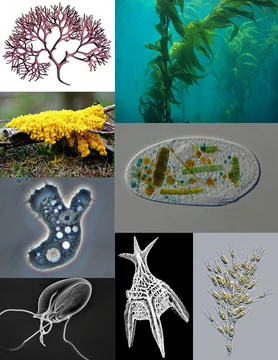
Chromalveolata
Proposed eukaryote supergroup later found not to be monophyletic.

Chromalveolata was proposed to represent the organisms descended from a single secondary endosymbiosis involving a red alga. The plastids in these organisms are those that contain chlorophyll c. However, the monophyly of the Chromalveolata has been rejected, and recent studies continue to support this view.
- known_for
- Proposed supergroup uniting organisms from a single secondary endosymbiosis with a red alga
Lore & Background
Chromalveolata was proposed to represent the organisms descended from a single secondary endosymbiosis involving a red alga. The plastids in these organisms are those that contain chlorophyll c. However, the monophyly of the Chromalveolata has been rejected.
Reader's Guide
Chromalveolata was a proposed supergroup that attempted to unite a diverse set of organisms—including cryptophytes, haptophytes, stramenopiles, and alveolates—under a common evolutionary origin from a single secondary endosymbiosis with a red alga. Many of these organisms were historically considered plants due to their cell walls, photosynthetic ability, and morphological resemblance to land plants. The group included both harmful and vital members: dinoflagellates cause red tides, apicomplexans are parasites (e.g., Plasmodium), and water molds cause plant diseases like the Irish potato blight. Conversely, diatoms are major photosynthetic producers, brown algae create underwater forest habitats, and many provide products such as algin and diatomaceous earth. The four original subgroups now fall into at least two categories: one comprises Stramenopiles and Alveolata (often with Rhizaria as the SAR group), and the other comprises Cryptophyta and Haptophyta (sometimes called Hacrobia). The rejection of Chromalveolata illustrates the ongoing refinement of eukaryotic classification based on molecular phylogenetics.
Did You Know?
- Chromalveolata was proposed to represent organisms descended from a single secondary endosymbiosis involving a red alga.
Frequently Asked Questions
Who is Chromalveolata?
Chromalveolata is a proposed eukaryote supergroup that was intended to unite all lineages whose plastids originated from a single secondary endosymbiosis event with a red alga. It was once treated as one of the major branches of the eukaryotic tree of life.
What are Chromalveolata's defining traits?
The hallmark of every member in this proposed group is a plastid that carries chlorophyll c, a pigment inherited from the original red-algal endosymbiont. That chlorophyll c signature was the primary biochemical clue researchers used to assemble the supergroup.
How does Chromalveolata's story end?
The monophyly of Chromalveolata was ultimately rejected, meaning the organisms once bundled together do not all descend from one shared ancestor. Subsequent phylogenetic analyses have continued to confirm that the supergroup does not form a valid single clade.
Why is Chromalveolata still important even after being dismantled?
The concept remains a landmark case study showing how secondary endosymbiosis reshaped eukaryotic diversity, and it stands as a cautionary example of how molecular phylogenetics can overturn long-standing taxonomic groupings. Fans and students still reference it when discussing the history of eukaryote classification.
What lineages were once grouped under Chromalveolata?
Before its rejection, the supergroup swept in a wide array of algae and protists—including diatoms, dinoflagellates, brown algae, and several other chlorophyll-c-bearing groups. All of these were linked by the assumption that their plastids traced back to the same red-algal endosymbiosis event.
More in Algae & Protists 1-19
Spotted an error? Know more?
This is a living reference — every entry is fact-audited, and reader corrections feed straight into our audit queue. Suggest an edit · See this site's audit record