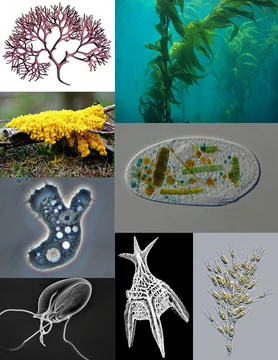
Cercozoa
Diverse single-celled eukaryotes united by molecular phylogenies.

Cercozoa is a phylum of diverse single-celled eukaryotes that lack shared morphological characteristics at the microscopic level and are instead united by molecular phylogenies of rRNA and actin or polyubiquitin. The group includes many amoeboids and flagellates that often feed using filose pseudopods, though not all such organisms are Cercozoa and many Cercozoa employ other feeding strategies. They are closely related to the phylum Retaria, together forming the supergroup Rhizaria.
- known_for
- Diverse eukaryotes united primarily by molecular phylogenies
Lore & Background
Cercozoa are a phylum of single-celled eukaryotes that show a variety of forms and have proven difficult to define in terms of structural characteristics, although their unity is strongly supported by phylogenetic studies. They include many amoeboids and flagellates that often feed by means of filose pseudopods, which may be restricted to part of the cell surface, but there is never a true cytostome or mouth as found in many other protozoa. Some cercozoans are grouped by whether they are 'filose' or 'reticulose' in the behavior of their cytoskeleton when moving. Filose examples include euglyphids, chlorarachniophytes, tectofilosids, cercomonads, and granofiloseans. Reticulose examples include Gromia, a shelled amoeba.
Reader's Guide
Cercozoa are significant as the first major eukaryotic group to be recognized mainly through molecular phylogenies, highlighting the power of genetic analysis in taxonomy. They show high ecological diversity, including many of the most abundant and ecologically significant protozoa in soil, marine, and freshwater ecosystems. Soil-dwelling cercozoans are one of the dominant groups of free-living eukaryotic microorganisms found in temperate soils, accounting for around 30% of identifiable protozoan DNA in arid or semi-arid soils and 15% in more humid soils. In transcriptomic analyses they account for 40-60% of all identifiable protozoan RNA found in forest and grassland soils. They also comprise 9-24% of all operational taxonomic units found on the ocean floor. Some cercozoa are coprophilic or coprozoic, using feces as a source of nutrients or as transport through animal hosts. Cercozoan bacterivores are highly diverse and important in the plant phyllosphere, where their predation causes shifts in bacterial communities. The phylum is composed of two subphyla: Filosa and Endomyxa, with ongoing research refining the internal relationships.
Did You Know?
- Cercozoa were among the first major eukaryotic groups to be recognized largely through molecular phylogenies.
- They lack shared morphological characteristics at the microscopic level and are instead united by molecular phylogenies of rRNA and actin or polyubiquitin.
- Soil-dwelling cercozoans can account for a significant portion of identifiable protozoan DNA in arid or semi-arid soils, though estimates vary by study.
- Some cercozoa are coprophilic or coprozoic, using feces as a source of nutrients or as transport through animal hosts.
Frequently Asked Questions
What is Cercozoa?
Cercozoa is a phylum of single-celled eukaryotes that do not share a common visible body plan at the microscopic level. They are grouped together on the basis of molecular phylogenies involving rRNA, actin, or polyubiquitin genes rather than on any single morphological trait.
How do Cercozoa typically feed?
Many members capture prey using filose pseudopods, though the phylum is far from uniform in its foraging strategies. Some are amoeboid, others are flagellated, and a number of Cercozoa rely on entirely different feeding mechanisms.
What is Cercozoa's relationship to Retaria?
Cercozoa and the phylum Retaria are close relatives that together form the supergroup Rhizaria. This sister-group pairing is a central organizing principle of the Rhizaria framework.
Why is Cercozoa difficult to define by appearance alone?
Members of the phylum lack a unifying set of visible microscopic characteristics that would let you spot them at a glance. Their unity rests almost entirely on molecular phylogenetic data rather than on shared anatomy.
Are all amoeboid or filose-pseudopod organisms Cercozoa?
No—while many Cercozoa are amoeboid or use filose pseudopods, the phylum is defined by genetic relationships rather than a single lifestyle. Plenty of amoeboid organisms fall outside Cercozoa, and not every filose-pseudopod feeder belongs to the group.
More in Algae & Protists 1-19
Spotted an error? Know more?
This is a living reference — every entry is fact-audited, and reader corrections feed straight into our audit queue. Suggest an edit · See this site's audit record