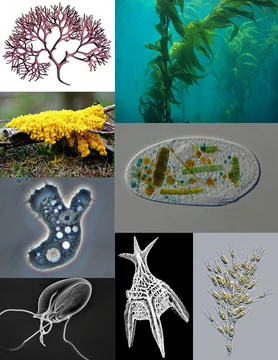
Dinoflagellate
Single-celled protists that cause red tides and glow blue-green.

Dinoflagellates are a monophyletic group of single-celled eukaryotes constituting the phylum Dinoflagellata, usually considered protists. They are mostly marine plankton but also common in freshwater habitats, with populations varying by sea surface temperature, salinity, and depth. Many are photosynthetic, though a large fraction are mixotrophic, combining photosynthesis with ingestion of prey. Some species are endosymbionts of marine animals and play an important part in coral reef biology, while others are unpigmented predators or parasitic. A rapid accumulation of certain dinoflagellates can cause red tide, a harmful algal bloom that can lead to shellfish poisoning, and some exhibit bioluminescence, primarily emitting blue-green light.
- field
- Protistology, Marine Biology
- known_for
- Causing red tides and bioluminescence; major marine eukaryotes with unique dinokaryon nucleus
Lore & Background
The term 'dinoflagellate' combines Greek 'dinos' (whirling) and Latin 'flagellum' (whip), referring to their distinctive swimming motion and flagella. In the 1830s, Christian Gottfried Ehrenberg proposed several genera still used today, including Peridinium, Prorocentrum, and Dinophysis.
Reader's Guide
Dinoflagellates are significant as one of the largest groups of marine eukaryotes, though substantially smaller than diatoms. Their ability to form harmful algal blooms (red tides) impacts human health through shellfish poisoning and affects marine ecosystems. Their bioluminescence, primarily blue-green, is visible in oceanic areas under certain conditions. They possess a unique cell covering called an amphiesma, with thecate species having cellulose plates forming a theca. Their nucleus, the dinokaryon, has chromosomes attached to the nuclear membrane with reduced histones and contains viral-origin DVNPs. Dinoflagellates are alveolates with two flagella, and their plastids derive from secondary endosymbiosis of red algae, with some from green algae or tertiary endosymbiosis of diatoms. Their evolutionary history is difficult to reconstruct due to their ability to transform from noncyst to cyst-forming strategies.
Did You Know?
- Dinoflagellates have a peculiar nucleus called a dinokaryon, where chromosomes are attached to the nuclear membrane and contain reduced histones.
- The dinoflagellate Erythropsidinium has the smallest known eye.
- Dinoflagellates can cause red tide, a harmful algal bloom that can cause shellfish poisoning if humans eat contaminated shellfish.
Taxonomic Placement Within the Alveolata Supergroup
Dinoflagellates are classified within the Alveolata, one of several large clades called supergroups that organize modern protist diversity. As flagellates, they belong to a lineage defined by a complex cytoskeleton anchored by a flagellar apparatus with basal bodies, from which microtubules radiate outward to scaffold the remaining cellular architecture. Historically, organisms like dinoflagellates were slotted into broad, informal categories such as algae or protozoa before molecular phylogenetics and electron microscopy revealed that seemingly unrelated forms were in fact evolutionarily connected while others that appeared similar were not. In current frameworks, dinoflagellates are understood as eukaryotes falling outside the three traditional higher kingdoms—animals, land plants, and fungi—placing them within the paraphyletic protist assemblage. This definition by exclusion means no single unifying trait sets all protists apart, yet dinoflagellates share the broader eukaryotic toolkit, including mitochondria and a complex endomembrane system inherited from the last eukaryotic common ancestor.
Cellular Architecture and Metabolic Versatility
Dinoflagellate cells display a remarkable range of nutritional strategies extending well beyond simple photosynthesis. Although they are recognized among phototrophs, many protists in their broader group blend chloroplast-based energy capture with specialized feeding structures for phagotrophy, osmotrophy, or even myzocytosis, a mode in which nutrients are drawn directly from living cells. This metabolic mixing, termed mixotrophy, allows them to persist through shifting environmental conditions. Their cytoskeleton is notably intricate, built around a conserved flagellar apparatus whose basal bodies launch microtubules to support the rest of the cell. Beyond locomotion, many harbor unique organelles such as contractile vacuoles for osmotic homeostasis or eyespots enabling light perception. Protist cells, including those of dinoflagellates, also tend to host internal symbionts—bacteria and archaea—that bolster their metabolism and nutrition. Despite the long-held assumption that such organisms reproduce only asexually, they are capable of sexual reproduction and can cycle through diverse life stages and generations, adding further layers of biological complexity.
Ecological Roles and Global Significance
Dinoflagellates are abundantly present across all ecosystems, including extreme habitats, where they serve as critical components of biogeochemical cycles and trophic webs. As photosynthetic producers, they contribute a substantial share of global primary production and carbon fixation, underpinning energy flow in aquatic and marine environments. Beyond their producer role, they participate in consumer and decomposer functions, helping regulate fungal and bacterial populations and releasing nutrients to higher trophic levels. Some form mutualistic partnerships with other organisms, including corals, where the relationship sustains both partners. Their ecological influence is not exclusively beneficial, however; free-living protists of this kind can trigger harmful algal blooms that negatively impact aquatic life. Their presence spans from microscopic single cells to organisms with thick-walled structures, and they coexist with a vast array of other protist forms in every habitat studied. Despite their ecological dominance, the comparatively low number of described species suggests that the majority of their diversity remains undocumented, a gap highlighted by environmental DNA studies.
Deep Evolutionary Roots and Ongoing Diversification
The evolutionary story of dinoflagellates is inseparable from the broader history of eukaryotic life. Eukaryotes split from archaea roughly three billion years ago, eventually producing a last eukaryotic common ancestor equipped with mitochondria and a complex endomembrane system during the Paleo- or Mesoproterozoic eras. In the 300-million-year window following the emergence of this ancestor, its descendants underwent a rapid diversification that gave rise to the modern supergroups, including the Alveolata to which dinoflagellates belong. Fossils from the gap between the archaeal split and the appearance of this common ancestor are often interpreted as stem-group eukaryotes bearing intermediate traits. Crown-group eukaryotes, including the dinoflagellate lineage, remained relatively scarce in the fossil record until the Neoproterozoic, when the first fossils of opisthokonts, amoebae, and multicellular algae appeared. Throughout the Phanerozoic, protists evolved into the forms that dominate ecosystems today, leaving behind an extensive fossil record of siliceous and calcareous shells. The dinoflagellate lineage thus represents a thread stretching back to the earliest chapters of complex cellular life.
Frequently Asked Questions
What is a Dinoflagellate?
Dinoflagellates are a monophyletic group of single-celled eukaryotic protists that make up the phylum Dinoflagellata. They are predominantly marine plankton, though many species also thrive in freshwater environments.
What are Dinoflagellates most famous for?
They are best known for producing red tides—massive blooms that discolor coastal waters—and for their striking blue-green bioluminescence when disturbed. These two phenomena make them one of the most visually dramatic protist groups.
What makes Dinoflagellates biologically unique?
They possess a highly unusual nucleus called a dinokaryon, in which chromosomes remain condensed even during interphase. Many species are also mixotrophic, blending photosynthesis with active predation on other microorganisms.
Where do Dinoflagellates live and what affects their populations?
They inhabit both marine and freshwater systems, with population density shifting in response to sea surface temperature, salinity, and depth. Some species also serve as endosymbionts inside coral and other marine animals.
Why are Dinoflagellates ecologically important?
As major marine eukaryotes, they form a critical base of aquatic food webs and contribute significantly to global oxygen production through photosynthesis. Their symbiotic relationships with corals are essential to reef ecosystem health, while harmful blooms can trigger mass fish kills.
More in Algae & Protists 1-19
Spotted an error? Know more?
This is a living reference — every entry is fact-audited, and reader corrections feed straight into our audit queue. Suggest an edit · See this site's audit record