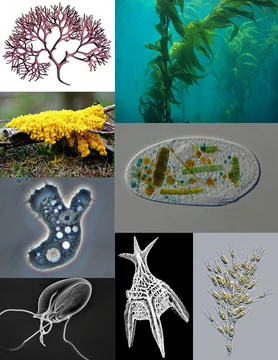
Chromista
Proposed kingdom of eukaryotes with chlorophyll c plastids.

Chromista is a proposed but controversial biological kingdom, refined from the Chromalveolata, consisting of single-celled and multicellular eukaryotic species that share similar features in their photosynthetic organelles (plastids). It includes all eukaryotes whose plastids contain chlorophyll c and are surrounded by four membranes.
- proposed_by
- Thomas Cavalier-Smith
- field
- Biology
- nationality
- British
- known_for
- Controversial kingdom of eukaryotes with chlorophyll c plastids
- key_groups
- Stramenopiles, Haptophytes, Cryptophytes
Lore & Background
According to Cavalier-Smith, the kingdom originally consisted mostly of photosynthetic eukaryotes (algae), but he later brought many heterotrophs (protozoa) into the proposed group. Notable members include marine algae, potato blight, dinoflagellates, Paramecium, the brain parasite Toxoplasma, and the malarial parasite Plasmodium. However, Cavalier-Smith's hypothesis of chromist monophyly has been rejected by many other researchers, who consider it more likely that some chromists acquired their plastids by incorporating another chromist instead of inheriting them from a common ancestor. This is thought to have occurred repeatedly, so that the red plastids spread from one group to another. The plastids, far from characterising their hosts as belonging to a single clade, thus have a different history from their disparate hosts.
Reader's Guide
Chromista represents a significant but disputed taxonomic concept in eukaryotic classification. Its members are defined by plastids containing chlorophyll c and enclosed in four membranes, derived from red algae through secondary symbiogenesis. The kingdom's diversity is vast, ranging from algae to parasites like Plasmodium. However, molecular evidence has led many researchers to reject monophyly, suggesting instead that the plastids were acquired through serial endosymbiosis among different host lineages. This controversy highlights the complexity of eukaryotic evolution and the challenges of reconstructing ancient symbiotic events. The debate continues, with some classifications placing chromist groups within the SAR supergroup or associating them with Archaeplastida. The kingdom's legacy lies in stimulating research into secondary endosymbiosis and the evolutionary history of photosynthetic eukaryotes.
Did You Know?
- Notable members include marine algae, potato blight, dinoflagellates, Paramecium, Toxoplasma, and Plasmodium.
- Many researchers reject chromist monophyly, proposing instead that plastids were acquired through serial endosymbiosis.
Frequently Asked Questions
Who is Chromista?
Chromista is a proposed biological kingdom introduced by British taxonomist Thomas Cavalier-Smith to unite eukaryotic organisms—both unicellular and multicellular—under one shared plastid architecture. It was carved out of the older Chromalveolata supergroup to spotlight a specific organelle signature common to its members.
What is Chromista's defining 'power' or key trait?
Every organism placed in this kingdom carries photosynthetic organelles (plastids) that contain chlorophyll c and are enclosed by four surrounding membranes. That four-membrane, chlorophyll-c plastid is the single structural feature that binds the group together.
Which major lineages fall under Chromista?
The kingdom is generally understood to encompass three key clades: Stramenopiles (diatoms, brown algae, oomycetes, and allies), Haptophytes (including coccolithophores), and Cryptophytes. Together they span a remarkable range of body plans, from microscopic flagellates to towering kelp forests.
Why is Chromista considered controversial?
Because it is a proposed rather than universally accepted kingdom, many systematists still prefer the broader Chromalveolata umbrella or split the included lineages along different phylogenetic lines. The four-membrane plastid criterion, while elegant, does not fully resolve all evolutionary relationships among the groups it gathers.
What is Chromista's current standing in the field?
As of the latest literature, Chromista remains a working hypothesis in eukaryotic taxonomy rather than a settled, universally ratified rank. It appears in many textbooks and research papers as a useful organizing concept, but its exact boundaries and validity continue to be debated among protistologists.
More in Algae & Protists 1-19
Spotted an error? Know more?
This is a living reference — every entry is fact-audited, and reader corrections feed straight into our audit queue. Suggest an edit · See this site's audit record