Euglenid
Single-celled flagellates with diverse nutrition and flexible pellicles.

Euglenids, also known as euglenoids, are a diverse group of single-celled eukaryotic flagellates classified in the phylum Euglenozoa, class Euglenida or Euglenoidea. They are best known for their flagella, or whip-like tails, and are commonly found in fresh water rich in organic materials, with a few marine and endosymbiotic members. Their significance lies in their varied modes of nutrition—phagocytosis, osmotrophy, and photosynthesis—and their distinctive cell covering called a pellicle, which can be rigid or flexible, enabling a unique inching motion known as metaboly.
- field
- Protistology
- known_for
- Diverse nutrition modes (phagotrophy, osmotrophy, phototrophy); pellicle with proteinaceous strips; metaboly motion; secondary endosymbiosis with green alga
- classification
- Phylum Euglenozoa, class Euglenida/Euglenoidea, supergroup Discoba
- earliest_fossil
- Moyeria, from Middle Ordovician and Silurian rocks
Lore & Background
Euglenids split from other Euglenozoa more than a billion years ago. Their plastids in all extant photosynthetic species result from secondary endosymbiosis between a euglenid and a green alga. Later, A.
Reader's Guide
Euglenids are a highly diverse clade within Euglenozoa, traditionally organized by nutrition into phototrophs (Euglenophyceae), osmotrophs (Aphagea), and phagotrophs (Heteronematina). Their pellicle, composed of proteinaceous strips, varies from rigid to flexible; only those with more than 18 strips gain flexibility and metaboly. Phylogenetic studies show rigid phagotrophs (e.g., Petalomonadida) at the base, while all flexible euglenids belong to the monophyletic Spirocuta. Reproduction occurs solely through asexual longitudinal binary fission, with no evidence of sexual reproduction. The earliest fossil, Moyeria, dates to the Middle Ordovician and Silurian, providing the oldest evidence of euglenids. Their classification remains under revision as molecular phylogeny refines traditional groups based on nutrition and flagella.
Did You Know?
- Euglenids split from other Euglenozoa more than a billion years ago.
- The pellicle is composed of proteinaceous strips; only euglenids with more than 18 strips can perform metaboly.
- No evidence of sexual reproduction has been found in euglenids; they reproduce by longitudinal binary fission.
- The earliest fossil of euglenids, Moyeria, is found in Middle Ordovician and Silurian rocks.
A Kingdom Defined by What It Isn't
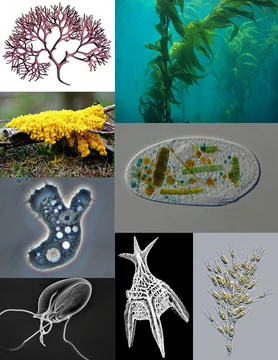
Protists occupy a peculiar position in biological taxonomy. Rather than being united by a shared derived characteristic, they are identified through a process of exclusion: any eukaryotic organism that does not qualify as an animal, a land plant, or a fungus falls under this umbrella. This makes the group paraphyletic, meaning it encompasses the entire eukaryotic tree of life minus the three higher kingdoms that evolved from within it. No single trait binds all protists together while excluding non-protists. Historically, these organisms were lumped into a kingdom called Protista or Protoctista, or scattered across the plant and animal kingdoms as algae and protozoa. The boundaries were notoriously blurry. Some organisms with fungus-like nutrition, such as oomycetes, were placed here, while red and green algae were often grouped with plants, and tiny animals like myxozoans were treated as protists. The arrival of molecular phylogenetics and electron microscopy shattered these assumptions, revealing that some algae were more closely related to protozoa than to other algae, and that seemingly unrelated forms shared deep evolutionary ties.
The Supergroup Mosaic
Modern taxonomy has scattered protists across several large clades called supergroups, each housing an astonishing variety of forms. Archaeplastida contains mostly phototrophic organisms like red and green algae, the lineage from which land plants ultimately emerged. Opisthokonta unites fungi, animals, and their single-celled relatives. Amoebozoa and Rhizaria shelter the bulk of amoeboid life, including testate amoebae, foraminifers, and radiolarians. Stramenopiles and Alveolata are rich in flagellates, many of which evolved into major parasites such as oomycetes and apicomplexans, or into phototrophs like diatoms, brown algae, and dinoflagellates. At the base of the tree sit the Excavata, which include euglenids and metamonads. These flagellates are thought to preserve ancestral traits of the last eukaryotic common ancestor, offering a window into what early eukaryotic cells might have resembled. Despite the relatively small number of formally described species, environmental DNA studies suggest protists account for the vast majority of eukaryotic diversity, with most species still waiting to be named.
Cellular Ingenuity in a Single Cell
Protist cells pack an extraordinary range of biological capabilities into structures that are often just a few micrometers across. Nutrition alone spans multiple strategies: some engulf particles through phagotrophy, others absorb dissolved nutrients via osmotrophy, still others extract cytoplasm directly from prey through myzocytosis, and many harbor chloroplasts for phototrophy. A large number combine autotrophic and heterotrophic modes in a strategy called mixotrophy. Respiration varies as well, reflecting modifications to their mitochondria. Nearly all protists possess a complex cytoskeleton built around a flagellar apparatus with basal bodies, from which microtubules radiate to scaffold the rest of the cell. Beyond this conserved architecture, many protists carry unique organelles such as contractile vacuoles for osmotic balance or eyespots for detecting light. Symbiotic bacteria and archaea frequently reside within protist cells, supporting their metabolism. Although long assumed to reproduce only asexually, protists are capable of sexual reproduction and can cycle through complex life stages involving different generations.
From Ancient Ancestors to Global Ecosystems
The story of protists is essentially the story of eukaryotic life itself. Eukaryotes diverged from archaea roughly three billion years ago, and the last eukaryotic common ancestor, equipped with mitochondria and a complex endomembrane system, likely arose during the Paleo- or Mesoproterozoic eras. In the 300 million years that followed, crown-group eukaryotes diversified rapidly into the supergroups we recognize today. Yet protist fossils remained sparse until the Neoproterozoic, when the first opisthokont, amoeboid, and multicellular algal fossils appeared. Throughout the Phanerozoic, protists evolved into the forms that dominate modern ecosystems, leaving behind extensive records of siliceous and calcareous shells. Ecologically, they are indispensable: as producers they drive a large share of global primary production and carbon fixation; as consumers and decomposers they regulate bacterial and fungal populations and recycle nutrients. They form mutualisms with corals and termites, yet also cause devastating diseases like malaria, toxoplasmosis, clubroot, and potato blight, and can trigger harmful algal blooms that devastate aquatic life.
Frequently Asked Questions
Who is Euglenid?
Euglenids are a diverse group of single-celled eukaryotic flagellates classified in the phylum Euglenozoa, class Euglenida (or Euglenoidea). They are most commonly encountered in nutrient-rich freshwater, though a small number of species occupy marine or endosymbiotic niches.
What are Euglenid's powers/role?
Euglenids can shift among three nutritional strategies—phagotrophy, osmotrophy, and phototrophy—giving them remarkable metabolic flexibility. Their cell is wrapped in a pellicle of proteinaceous strips that can toggle between rigid and flexible states, producing a distinctive inching locomotion called metaboly.
How does Euglenid's story end?
The earliest known euglenid fossil, Moyeria, is preserved in Middle Ordovician and Silurian rock layers, pushing the lineage back well over 400 million years. Because the group is still ecologically active in freshwater habitats today, their story is far from over.
Why is Euglenid important?
Euglenids are a cornerstone of protistology because their mixed nutrition modes and secondary endosymbiosis with a green alga shed light on how complex eukaryotic cells evolved. Their flexible pellicle and metaboly motion also make them a go-to model in cell-biology research.
Where does Euglenid fit in the tree of life?
Euglenids sit within the supergroup Discoba, nested under the phylum Euglenozoa and the class Euglenida/Euglenoidea. This placement groups them with other discoban lineages rather than treating them as simple algae or animal relatives.
More in Algae & Protists 1-19
Spotted an error? Know more?
This is a living reference — every entry is fact-audited, and reader corrections feed straight into our audit queue. Suggest an edit · See this site's audit record