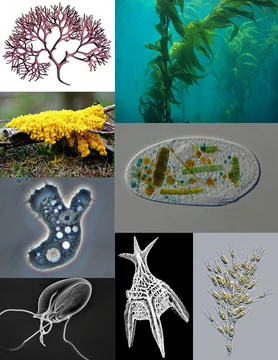
Ciliate
Ciliates are protists with cilia and two types of nuclei.

Ciliates are a group of alveolates characterized by the presence of hair-like organelles called cilia, which are identical in structure to eukaryotic flagella but are generally shorter and more numerous, with a different undulating pattern. They are an important group of protists, common almost anywhere there is water, including anoxic habitats, and include some of the most morphologically complex protozoans.
- field
- Protistology
- known_for
- Possessing two distinct nuclei (micronucleus and macronucleus) and using cilia for locomotion and feeding
- size_range
- 10 μm to 4 mm
Lore & Background
Ciliates reproduce asexually by various kinds of fission, including transverse fission, budding, strobilation, and palintomy. During fission, the micronucleus undergoes mitosis and the macronucleus elongates and undergoes amitosis, except among Karyorelictean ciliates. Conjugation is a sexual phenomenon that results in genetic recombination and nuclear reorganization, during which two ciliates of compatible mating types exchange haploid micronuclei.
Reader's Guide
They occupy nearly every aquatic habitat, including oxygen-depleted environments, and exhibit a wide range of feeding strategies, from heterotrophy and mixotrophy to parasitism. Their unique nuclear dualism—with a germline micronucleus and a somatic macronucleus—provides a model for studying genome rearrangement and aging. The presence of alveoli, ciliary structure, and mitotic details links them to Apicomplexa and dinoflagellates within the alveolates. Only one species, Balantidium coli, is known to cause disease in humans. Their complex infraciliature and varied reproductive strategies, including conjugation and autogamy, make them a key group for understanding eukaryotic cell biology and evolution.
Did You Know?
- Ciliates have two different sorts of nuclei: a tiny, diploid micronucleus and a large, ampliploid macronucleus.
- The ciliate Halteria has been observed to feed on chloroviruses.
- Only one ciliate species, Balantidium coli, is known to cause disease in humans.
- In some older systems of classification, ciliated protozoa were placed within the class 'Ciliata', a term which can also refer to a genus of fish.
Taxonomic Identity in a Shifting Classification
Ciliates occupy a peculiar position in biological taxonomy. Defined by exclusion rather than by any single unifying trait, they belong to the broad category of protists—eukaryotic organisms that fall outside the three 'higher' kingdoms of animals, land plants, and fungi. This makes the protist grouping paraphyletic: it encompasses the entire eukaryotic tree of life from which those three lineages eventually branched off. Historically, ciliates and their relatives were lumped into a kingdom called Protista or Protoctista, or scattered between the plant and animal kingdoms as 'algae' and 'protozoa.' The advent of molecular phylogenetics and electron microscopy shattered these neat boxes. Organisms once thought unrelated turned out to share deep evolutionary ties, while apparent cousins proved to be distant relatives. In modern frameworks, protists are distributed across several large supergroups, each containing a mosaic of disparate forms. Ciliates, as one of the many morphological types within this sprawling diversity, resist easy placement and remind us that the eukaryotic tree of life is far more tangled than early taxonomists imagined.
Cellular Architecture and Metabolic Range
Although ciliates are primarily single-celled, their internal architecture is remarkably intricate. Nearly all protists, including ciliates, possess a complex cytoskeleton built around relatively conserved structures that have persisted across evolutionary time. Central to this framework is a flagellar apparatus anchored by basal bodies, from which microtubules radiate outward to scaffold the remaining cellular components. Beyond this structural backbone, ciliates may carry specialized organelles such as contractile vacuoles that maintain osmotic homeostasis or eyespots that allow them to sense light. Their metabolic strategies are equally varied: some feed by engulfing particles (phagotrophy), some absorb dissolved nutrients (osmotrophy), some extract nutrients directly from host cells (myzocytosis), and some harness sunlight through chloroplasts (phototrophy). Many blend autotrophic and heterotrophic strategies in a mode called mixotrophy. To support these diverse nutritional demands, ciliate cells frequently harbor symbiotic bacteria and archaea, forming internal partnerships that bolster their metabolism.
Ecological Roles Across Ecosystems
Ciliates are abundantly present in virtually every ecosystem on Earth, including extreme habitats that would seem inhospitable to most life. Within these environments, they serve as critical components of biogeochemical cycles and trophic webs. As primary producers, protists contribute a substantial share of global primary production and carbon fixation, converting inorganic carbon into organic matter that fuels food chains. As consumers and decomposers, ciliates help regulate populations of fungi and bacteria, releasing locked nutrients back into the environment for other trophic levels to access. Some ciliates engage in mutualistic partnerships with other protists or with animals such as corals and termites, providing services that sustain their hosts. On the darker side, certain protist lineages have evolved into significant parasites, causing well-known human and animal diseases like malaria and toxoplasmosis, or devastating plant diseases such as clubroot and potato blight. Free-living protists can also generate harmful algal blooms that disrupt aquatic ecosystems.
Deep Evolutionary Roots and Rapid Diversification
The evolutionary story of ciliates is inseparable from the broader history of eukaryotes. Eukaryotic life split from the archaeal lineage roughly three billion years ago, and the last eukaryotic common ancestor (LECA) emerged sometime during the Paleo- or Mesoproterozoic eras, already equipped with mitochondria and a complex endomembrane system. In the interval between the archaeal split and LECA, fossils are often interpreted as stem-group eukaryotes bearing intermediate traits. Once LECA appeared, its descendants underwent a burst of rapid diversification spanning approximately 300 million years, giving rise to the modern supergroups within which ciliates now reside. Despite this ancient origin, the fossil record of protists remained sparse until the Neoproterozoic, when the first fossils of opisthokonts, amoebae, and multicellular algae finally appear. Throughout the Phanerozoic, protists continued to evolve into the forms that dominate ecosystems today, leaving behind an extensive record of primarily siliceous and calcareous shells. The comparatively low number of formally described species belies their true abundance, as environmental DNA studies reveal that most protist diversity remains undescribed.
Frequently Asked Questions
What is a Ciliate?
A Ciliate is a type of alveolate protist whose defining trait is the dense covering of short, hair-like structures called cilia. These cilia beat in a coordinated wave pattern to propel the organism and sweep food toward its mouth.
What makes Ciliates unique compared to other protists?
Ciliates carry two separate nuclei in a single cell: a small micronucleus and a larger macronucleus, each serving different genetic roles. This dual-nucleus setup, combined with their cilia-based locomotion and feeding, sets them apart from flagellates and amoebae.
How big do Ciliates get?
Individual ciliate cells range from roughly 10 micrometres up to about 4 millimetres in length, making them among the largest single-celled organisms you can encounter in a pond sample.
Where do Ciliates live?
Ciliates are found in virtually every aquatic environment on Earth, from freshwater ponds to marine sediments, and even in oxygen-poor (anoxic) habitats where few other protists thrive.
Why are Ciliates important in protistology?
They represent some of the most morphologically complex protozoans known, with elaborate cell structures and a two-nucleus system that make them a key model for studying eukaryotic cell biology and protist diversity.
More in Algae & Protists 1-19
Spotted an error? Know more?
This is a living reference — every entry is fact-audited, and reader corrections feed straight into our audit queue. Suggest an edit · See this site's audit record