Frequently Asked Questions
The most-asked questions about algae & protists.
What exactly are algae & protists?
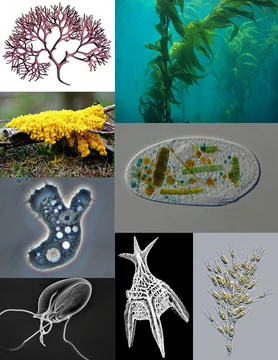
Algae and protists are a diverse collection of mostly single-celled or simple multicellular eukaryotic organisms that don't fit neatly into the animal, plant, or fungal kingdoms. They range from microscopic diatoms to giant kelp forests and include essentially every eukaryotic organism that photosynthesizes or drifts in aquatic environments without being a 'true' plant.
Who are the key figures in protist research?
Ernst Haeckel coined the kingdom 'Protista' in 1866 and set the early taxonomic framework, while modern systematists like Thomas Cavalier-Smith and the Adl consortium (2005) repeatedly reorganized the field using molecular phylogenetics. In popular and educational contexts, the diatom group and the dinoflagellate Noctiluca often serve as the most recognizable 'faces' of the entire category.
Where should a newcomer begin exploring?
Start with a general biology textbook chapter on protists to get the big-picture taxonomy, then branch into a focused resource on one group—such as diatoms, dinoflagellates, or ciliates—to build depth. Most university open-courseware modules titled 'Eukaryotic Diversity' or 'Microbial Eukaryotes' are solid free entry points.
What's the difference between 'algae' and 'protists'?
'Protist' is a formal taxonomic bucket for eukaryotes that aren't animals, plants, or fungi, while 'algae' is a functional term for any photosynthetic organism in that bucket. In other words, all photosynthetic protists are algae, but not all algae are protists, since red and green algae are sometimes placed within the broader plant lineage.
What are some of the most iconic species?
Diatoms (Bacillariophyta) are often called the 'jewelry of the sea' for their intricate silica shells, while dinoflagellates like Noctiluca produce the famous bioluminescent 'sea sparkle.' On the multicellular end, giant kelp (Macrocystis) and the red alga Porphyra (nori) are the household names.
Where do protists sit in the tree of life?
Protists are not a single clade but a grab-bag of lineages that branched off before or alongside the animals, plants, and fungi, making them the 'everything else' eukaryotic branch. Major supergroups include SAR, Excavata, Amoebozoa, and Archaeplastida, each carrying its own distinct evolutionary story.
What are some landmark moments in protist science?
Haeckel's 1866 naming of 'Protista' gave the group its first formal identity, and the 1990s–2000s molecular phylogeny revolution repeatedly reshuffled the taxonomy. The recurring discovery that many 'algae' are actually symbiotic partnerships—such as coral zooxanthellae—has been a persistent plot twist in the field.
How much biodiversity are we talking about?
Estimates of described protist species range from roughly 40,000 to over 80,000, and many ecologists believe the true number of eukaryotic microbial species is in the millions. Diatoms alone are thought to account for 100,000 or more species, the vast majority still undescribed.
Why do protists matter to ecosystems and to us?
Protists generate an estimated 20–50% of Earth's oxygen through photosynthesis and form the base of nearly every aquatic food web. They also drive nutrient cycling, cause harmful algal blooms, and include both beneficial symbionts and dangerous pathogens like Plasmodium (malaria) and Trypanosoma (sleeping sickness).
Are protists more related to animals, plants, or fungi?
There's no single answer because protists are paraphyletic—different groups are closer to different 'true' kingdoms. Choanoflagellates are the closest known relatives of animals, glaucophytes and red algae are sister to green plants, and some amoebozoans show structural affinities with fungi.